
Back Pain While Sitting: Causes and Relief in Colleyville, TX
Nervous-system-informed care for back pain that builds at your desk, on the couch or behind the wheel in Colleyville, TX, guided by CLA INSiGHT scans, not guesswork.
❖ Personalized, One-on-One Care
❖ Cash-Based, No Insurance Required
❖ Webster Certified
❖ CLA INSiGHT Technology
Sitting can hurt more than standing because it loads your lower back more. Harvard Health’s advice on sitting with back pain explains that pressure on the disks of the lower back is lowest when you are lying down, and higher when you sit than when you stand. In short stretches, that is not a problem for most people. Over a full workday, a long drive or an evening on the couch, it adds up.
A few things tend to be going on at the same time:
- Disk pressure: sitting loads the lower back disks more than standing, which matters most when there is an irritated or herniated disc
- Tight, tired muscles: Harvard Health notes that many people report tighter and more painful back muscles with prolonged sitting
- Slumped posture: the lower back rounds and the head drifts forward toward the screen
- Stillness: holding one position for hours, even a good one, leaves the back stiff
Mayo Clinic’s office ergonomics guide puts that last point plainly: sitting in the same position for hours at a time isn’t good for your body, even with a well set up workstation. Posture matters, but movement matters just as much.
Where the pain goes is a useful clue. Pain that stays in the lower back and eases when you stand and walk often points to the muscles and joints. Pain that travels into the buttock or down a leg suggests a nerve may be involved, as with sciatica pain down the leg. A deep ache low on one side, near the top of the buttock, that builds with long sitting can also come from the joint where the spine meets the pelvis, and SI joint pain from sitting has its own pattern.
In our Colleyville practice, we look at both sides of the problem: a posture and movement review shows how your spine and hips are moving, and a CLA INSiGHT scan shows whether muscle tension and nervous system stress are concentrated in one area or spread out.
The right desk setup for back pain takes real load off your back: chair height, screen position and keyboard placement. Mayo Clinic’s office ergonomics guidance is a good starting checklist:
- Chair: choose one that supports your spine, and adjust the height so your feet rest flat on the floor or on a footrest, with your thighs level so your hips aren’t sinking below your knees
- Screen: place it straight ahead, about an arm’s length away, with the top at or slightly below eye level
- Keyboard: put it in front of you so your wrists and forearms line up and your shoulders stay relaxed
- Reach: keep the things you use most within easy reach so you aren’t stretching or twisting to grab them
Laptops are a common trouble spot, because the screen and keyboard are attached. When the screen sits low, your head and upper back drift forward to meet it. A separate keyboard and a laptop stand can bring the screen up toward eye level.
Driving brings its own version of the same problem. Sit upright with your back against the seat, bring the seat close enough that you aren’t reaching for the wheel, and use a small cushion or rolled towel behind your lower back if the seat doesn’t support it. On longer drives, a short stop to stand and walk helps.
The couch is the sneakiest of the three. Sinking into deep cushions with your head tipped toward a phone keeps the lower back rounded for a long time and invites screen-driven tech neck. A firmer seat, a pillow behind your lower back, and getting up between episodes all help. If long days at a desk also leave your neck and shoulders tight, desk posture strain care covers that side too.
The single best change is often the simplest: get up more often. Harvard Health suggests getting up at least every 30 minutes and walking around if you sit at a desk, and taking short walks through the day, like refilling your water or checking the mail. Mayo Clinic recommends standing when you can and getting up to walk around as often as you can during the workday.
- Set a reminder to stand and move every 30 minutes
- Take phone calls standing up or walking
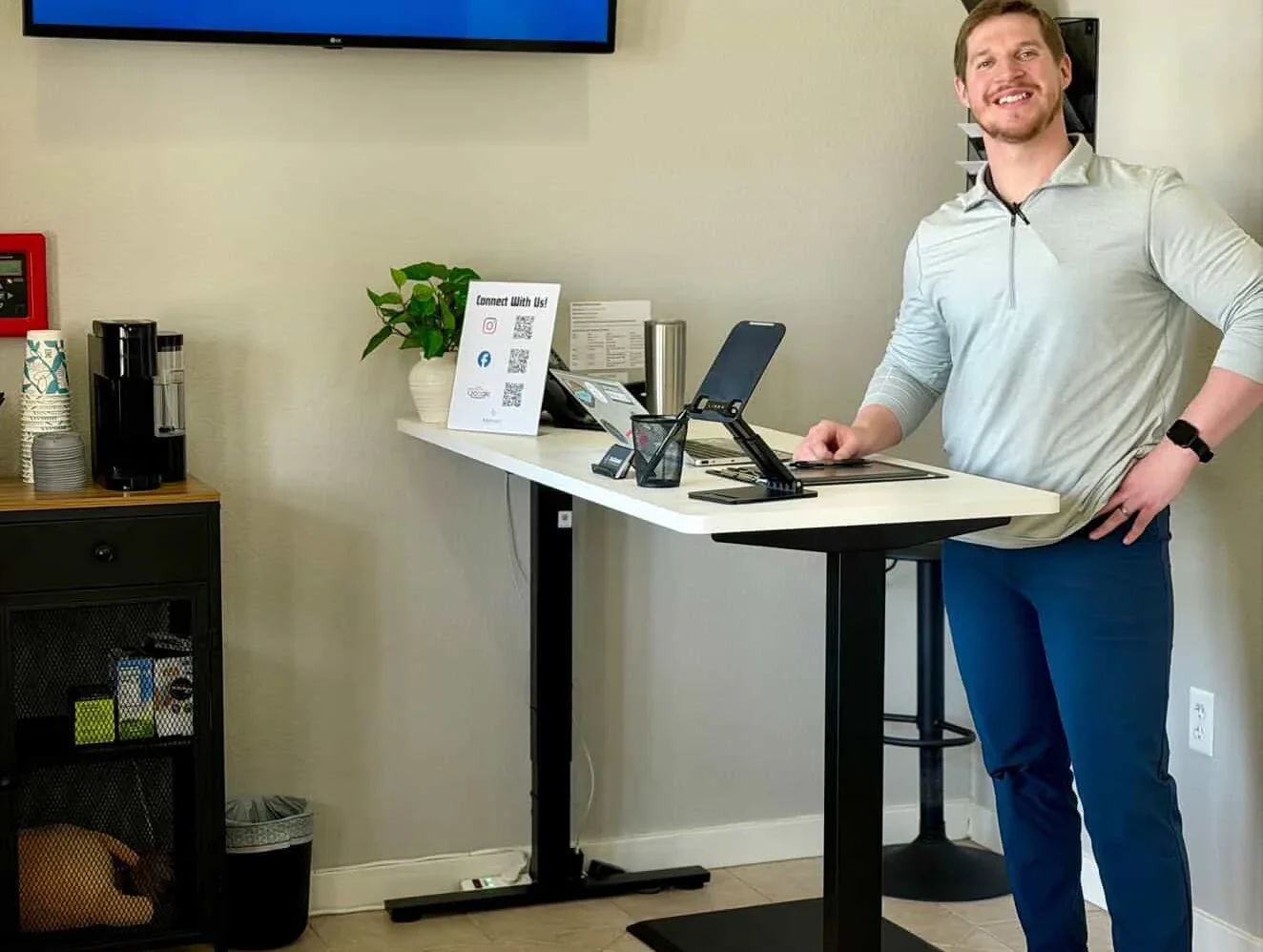
- Use a standing desk for part of the day if you have one, and keep changing positions
- Walk for a few minutes after meals or before the drive home
If sitting does set off pain, Harvard Health suggests lying down to relieve it, then aiming to get back up and moving rather than returning to the same chair. The NHS guide to back pain gives similar advice for back pain in general: stay active, keep up your daily activities and avoid long periods in bed. It also notes that back pain usually improves within a few weeks.
In our office, care for back pain while sitting follows the same approach as our back pain and sciatica treatment. It usually combines chiropractic adjustments with practical changes to your desk, car and daily routine, based on what your exam and CLA INSiGHT scan show.
Some back pain needs a medical evaluation first. The NHS advises seeing a doctor if the pain hasn’t improved after a few weeks, is stopping you from doing your day-to-day activities, is worse at night or doesn’t ease with rest, or comes with unexplained weight loss. Get urgent care if you feel feverish or generally unwell along with the pain, or if severe pain starts suddenly. Get emergency care right away for pain, numbness or weakness in both legs, numbness around the genitals or bottom, new trouble controlling your bladder or bowels, chest pain, or pain that starts after a serious accident.
Why does my lower back hurt when I sit but not when I stand or walk?
Sitting puts more pressure on the disks in your lower back than standing does, according to Harvard Health, and holding one position for a long time can leave your back muscles tight and tired. When you stand up and walk, that load shifts and your muscles get to move, which is why many people feel better once they are on their feet. Harvard Health suggests getting up at least every 30 minutes.
Is it normal for my back to hurt while sitting?
Occasional stiffness after a long stretch in a chair is common, and the NHS notes that most back pain improves within a few weeks. Pain that shows up every time you sit, keeps coming back, or isn’t improving after a few weeks is worth getting checked. So is pain that travels into your leg, which can point to a nerve being involved.
Is a standing desk better for back pain?
Mayo Clinic notes that sitting in the same position for hours isn’t good for your body, and recommends standing when you can and moving often. A standing desk can make it easier to change positions through the day, but the real benefit comes from switching positions often, not from standing all day.
Can a chiropractor help with back pain from sitting?
A chiropractor can evaluate how your spine and hips are moving and how much tension your back is carrying. At Radiant Chiropractic, that includes a CLA INSiGHT scan. Care usually combines adjustments with practical changes to your desk, car and daily routine, and we will refer you if your symptoms point to something that needs medical care.

Schedule Now
Looking for a family chiropractor in Colleyville, TX? At Radiant Chiropractic, every care plan starts with a real assessment, not a guess. Schedule your first visit and see what’s actually going on.
What Colleyville Families Are Saying
Real feedback from the families we’ve had the privilege to care for


 Trustindex verifies that the original source of the review is Google.
 Trustindex verifies that the original source of the review is Google.

 Trustindex verifies that the original source of the review is Google.
 Trustindex verifies that the original source of the review is Google.
 Trustindex verifies that the original source of the review is Google.
 Trustindex verifies that the original source of the review is Google.
 Trustindex verifies that the original source of the review is Google.
 Trustindex verifies that the original source of the review is Google.

 Trustindex verifies that the original source of the review is Google.
 Trustindex verifies that the original source of the review is Google.
Visit Our Office
Contact us for expert chiropractic care in Colleyville, TX.
PHONE - Call or Text 📱
HOURS
Monday: 9:00am–1:00pm, 4:00pm–7:00pm
Tuesday: 4:00pm–7:00pm
Wednesday: 9:00am–1:00pm, 4:00pm–7:00pm
Thursday: 9:00am–1:00pm, 4:00pm–7:00pm
Friday: Closed
Saturday: Closed
Sunday: Closed